
Latest Updates & Changelog

Follow new updates and improvements to PostSnag.

10 New Updates: Comments Are Here, AI That Runs Your Library, and a Whole New Look!
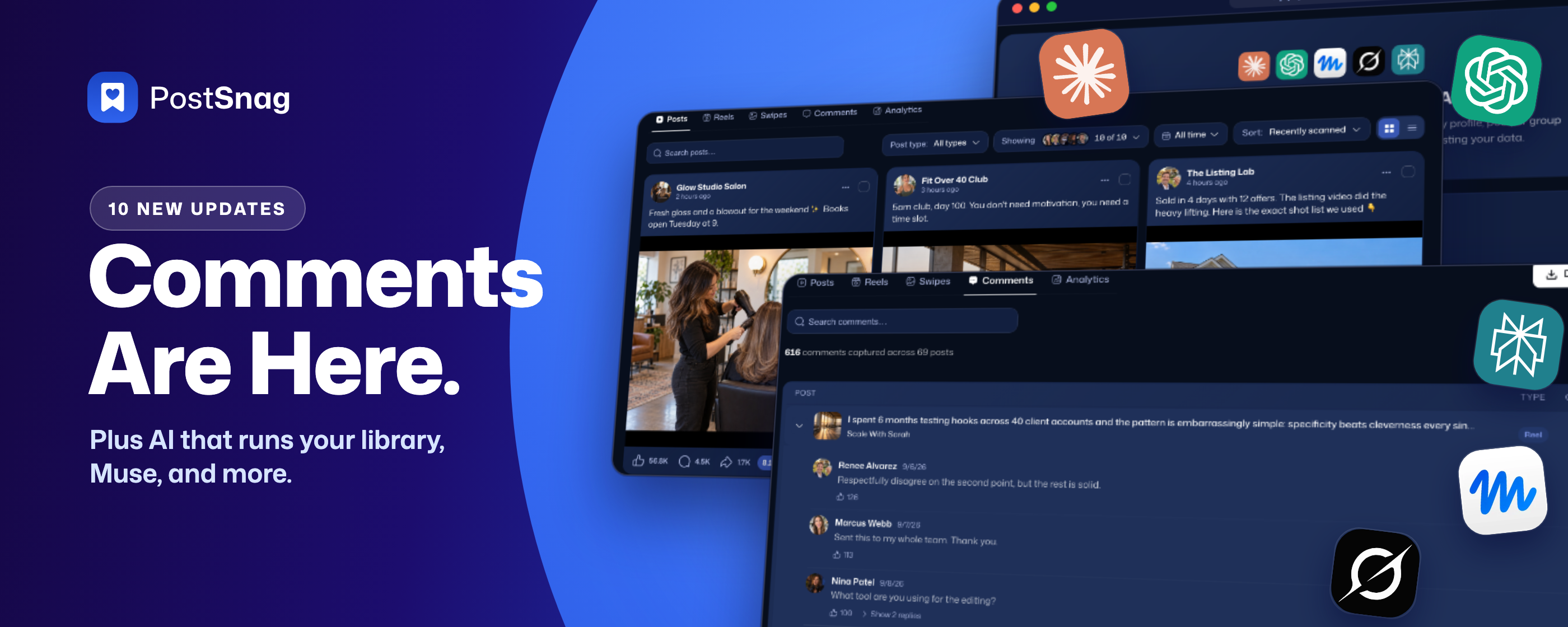
We got 10 updates coming your way, and the first one is the one you have been asking for the most. Last time we gave you Swipe, Folders, and PostSnag inside Grok and Perplexity. Since then we went heads down on the conversation under every post, a faster extension, and a dashboard that looks and works the same everywhere you go.

This update has 10, and the first one is brand new:

  • πŸ’¬ Comments (capture and download the comments on any post, profile, or group)

  • πŸ”– Bookmarks in the extension (see what you saved without leaving Facebook)

  • ⚑ Faster capture (20 to 30 posts per scroll instead of about 5)

  • πŸ‘₯ Profiles (new cards, and top and outlier profiles one click away)

  • πŸͺͺ Profile makeover (posts that look like Facebook, and a Comments tab)

  • πŸ“° Posts (the same new cards and tabs across your whole library)

  • 🏘 Groups (a cleaner page and a big Download Group Data button)

  • πŸ€– The MCP (Muse, 28 tools, and comments inside your AI)

  • πŸ“ Folders (one layout, every tab, smarter with the MCP)

Before we get into it, make sure you are on the latest Chrome extension. Close out and reopen your browser and it updates itself.

Let's get into it πŸ‘‡


1. Comments

Brand new, and the one you asked for the most. You can now export the comments on any Facebook post, on a profile or inside a Facebook group. Open the post, scroll, and watch the comments download.

  • Open the post and scroll. Go to the post itself and scroll down, and the sidebar jumps to a new Comments tab and counts them as they come in: who wrote it, what they said, when, how many likes, and the replies nested under the comment they answer.

  • Switch to All comments first. Facebook opens most threads on Most relevant, which hides comments it thinks are spam. Switch the thread to All comments before you scroll so you grab everything Facebook will show you. Each row shows how many you captured out of Facebook's total, like 142/177.

  • Export one post, or all of them. Hit the arrow on a row to export that one post's comments, or hit Export Comments at the top to send everything you captured in bulk. Your dashboard opens right on the Comments tab.

  • Or start from a link. Paste any post link into a tab, a profile post, a Page post, or a group post, and PostSnag captures the post and its comments without scanning the whole profile first.

  • A new Comments tab in your dashboard. Every post you exported comments from is listed with its thumbnail, author, type, and how many you captured. Click the dropdown to read the whole thread, replies included.

  • Download for AI. Download the comments of one post, or all of them at once, as a Markdown file and a CSV ready for Claude or ChatGPT. Every CSV row repeats the post's author, caption, and link, so each row still makes sense on its own.

  • Works in Facebook groups too. Group posts, and the profiles of members inside a group, capture comments the same way, and every group has its own Comments tab.

  • Search and bookmark. Search inside the comments themselves, and bookmark any single comment to find it later under Bookmarks, then Comments.

  • Instantly available in the MCP. Ask Claude, ChatGPT, Muse, Perplexity, or Grok to pull a post's comments, list comments across your library, or pull whole comment threads with every reply.


2. Bookmarks in the extension

See what you already saved without leaving Facebook.

  • Your saved posts, right in the sidebar. On any profile, a new Bookmarks tab lists the posts from that profile you bookmarked or saved to a folder in your dashboard. It is a quick double check of what you already have.

  • One click to the post. Click any saved post in the list and it takes you straight to it on Facebook. You can remove a bookmark from the sidebar too.


3. Faster capture

The not glamorous update, but the one you will notice the second you scroll.

  • 20 to 30 posts per scroll. PostSnag used to pick up about 5 posts each time you scrolled. Now it picks up 20 to 30. In the video, two scrolls pulled in 36 posts.

  • Why it is faster. Facebook quietly loads the next batch of posts before they reach your screen. PostSnag now reads that whole batch as it loads, instead of waiting for each post to scroll into view.

  • Less scrolling for everything. Profiles, Pages, and Facebook groups all fill up faster, so you get to export sooner.


4. Profiles

The Profiles page got cards that tell you more at a glance, and a simpler menu.

  • New profile cards. Each card shows the creator's cover, their profile photo, and their posts, groups, and folders counts.

  • See which groups they are in. If a creator is inside any Facebook group you scanned, the group shows on their card. Click it and it takes you to that person inside that group on Facebook, where their group posts are.

  • Top, Outlier, and Analytics in one menu. Tabs across the top take you to your top profiles, your outlier profiles, and analytics across every profile you have scanned, so it is faster to see who you should be paying attention to.

  • Filter by group. A Group filter shows only the creators from the groups you pick.


5. Profile makeover

Open any profile and everything got a makeover, from the header down to the posts.

  • A cleaner header. Simpler and easier to read, with the stats as tiles and In Folders, View on Facebook, and the three-dot menu together at the top right.

  • One set of tabs everywhere. Posts, Reels, Swipes, Comments, and Analytics, in the same order you will find across the whole platform.

  • A big Download Profile Data button. Download the data, the media, or both together, ready for AI.

  • Posts that look like Facebook. The small four-column grid is gone. Posts now show in three wide columns and look exactly like they do on Facebook: the byline, the text with See more, the full image, and the like, comment, and share counts.

  • Colored-background posts. Text-only posts written on a colored or gradient background now show that background, just like on Facebook.

  • A Comments tab on every profile. See how many comments you captured across that creator's posts, open any post to read the full thread with replies, and export them for AI. Then ask your AI things like "What's working in Austin's content, and how are people reacting in the comments?"


6. Posts

The Posts page, your whole library in one place, got the same refresh.

  • The new three-column cards. The same Facebook-style cards as profiles, across every post you have captured.

  • New tabs. Reels, Swipes, Comments, and Analytics now sit next to Posts, so you can flip between every reel, every image, and every comment you have captured.

  • Pick who you see. The Showing menu lets you select and deselect creators, so you can look at a handful at a time or everyone at once.


7. Groups

Groups got an overhaul so they match everything else.

  • A cleaner Groups page. Easier to read and easier to navigate, with a Profiles by group tab that shows every member of each group you scanned.

  • The same layout inside every group. A new header, then Posts, Profiles, Reels, Swipes, Comments, and Analytics tabs.

  • Comments in groups. Every group has its own Comments tab for the group posts you captured comments from.

  • A big Download Group Data button. Download your group's data, media, or both, fast and easy.


8. The MCP

We massively updated the MCP, and Muse joins the list.

  • Muse is here. Muse is Meta's AI agent, and it joins Claude, ChatGPT, Grok, and Perplexity. The MCP page walks you through connecting it in three steps, with its own setup video.

  • 28 tools, up from 12. 16 for reading your data, 9 for writing (your AI can now organize your library for you, see below), and 3 for exporting.

  • Ask your AI about the comments. Capture the comments on any post, profile, or group, then ask your AI what you want to know. "Look at this post, what's the common sentiment?" "Look at this Facebook group, what are people frustrated by?"

  • Put it on a schedule. Use it with Muse, Claude, or ChatGPT to run on a schedule. "Every Friday, look at the comments on my posts from this week and tell me what people liked and didn't like."


9. Folders

Folders got a simpler makeover and a smarter connection to the MCP.

  • A header with the quick info. Posts, profiles, groups, swipes, likes, comments, and shares for the whole folder, at the top.

  • Every tab in one place. Posts, Profiles, Groups, Reels, Swipes, Comments, and Analytics, so you see everything you saved to that folder, including the comments you captured.

  • The same layout as everywhere else. Profiles, groups, folders, and Bookmarks now share one layout, so once you know one, you know them all.

  • Smarter with the MCP. Your AI can now create folders, file posts, profiles, groups, and images into them, and export a whole folder for you (see below).


Everything else in this update

The rest of what landed, grouped up. None of these needed their own video, but you will run into all of them.

Your AI can organize your library

  • Create and file by asking. Your AI can create a folder, rename it, recolor it, pin it, and add or remove posts, profiles, groups, and single images. Try "Take these creators' top reels and put them in a folder called Reel Winners."

  • Bookmark by asking. Posts, profiles, groups, comments, and single slides inside an album.

  • Delete, with a safety net. Your AI can delete folders or library items. Deleting a folder keeps what was inside it. Nothing on Facebook is touched, and your AI is told to list what will go and check with you first.

  • Undo. Ask your AI to undo its last change and it reverses it, one step at a time, for up to 30 days.

  • Export a folder from the chat. Say "download this whole folder" and your AI starts the export and hands you the link when it is ready.

  • Sharper answers. Searching inside one creator no longer mixes in other creators' posts, a creator inside a group returns only their posts in that group, and top posts no longer under-count a creator.

  • Writing tools need Pro or Lifetime, like the rest of the MCP.

In the extension

  • Clearer words. Collected is now Posts, Synced is now Saved (amber while it captures, green when done), and Export To Dashboard is now Export Posts.

  • Fresh every visit. The sidebar and Export use only what you captured on this visit, so things you deleted in your dashboard don't come back.

In the dashboard

  • Custom date range. Pick Last 7, 30, or 90 days, All time, or your own dates on Posts, every group, and every folder.

  • A rebuilt post popup. Every post opens in the same size box with the whole image, and Caption and Comments tabs. Copy or download the caption in one click.

  • Card or table on every feed, and one multi-select bar with the same actions everywhere.

  • Swipes, a step further. A Swipes tab on Posts and Bookmarks, a table view, Filed here and Found inside chips in folders, and Swipes counts on folders and Bookmarks.

  • Delete a folder. Hover a folder card and confirm. Your posts, profiles, and groups are kept.

  • Bookmarks looks like a folder, with the same seven tabs.

  • Faster and safer folders. The Folders page loads its counts much faster, and adding a selection to a folder no longer removes posts from folders you didn't touch.

  • A What's new card in the bottom left of your dashboard, so you never miss an update.

  • Smaller fixes. Downloading a post's media works, chart colors are easier to tell apart, MCP has its own link in the phone menu, and a folder no longer flashes empty while it loads.


This is just the start

Everything above landed in the three weeks since the last update. Update the PostSnag Chrome Extension, open any post on Facebook, switch it to All comments, scroll, and hit Export Comments. Then ask your AI what people are really saying. Tell us what to build next on the roadmap. We are listening.
Improved

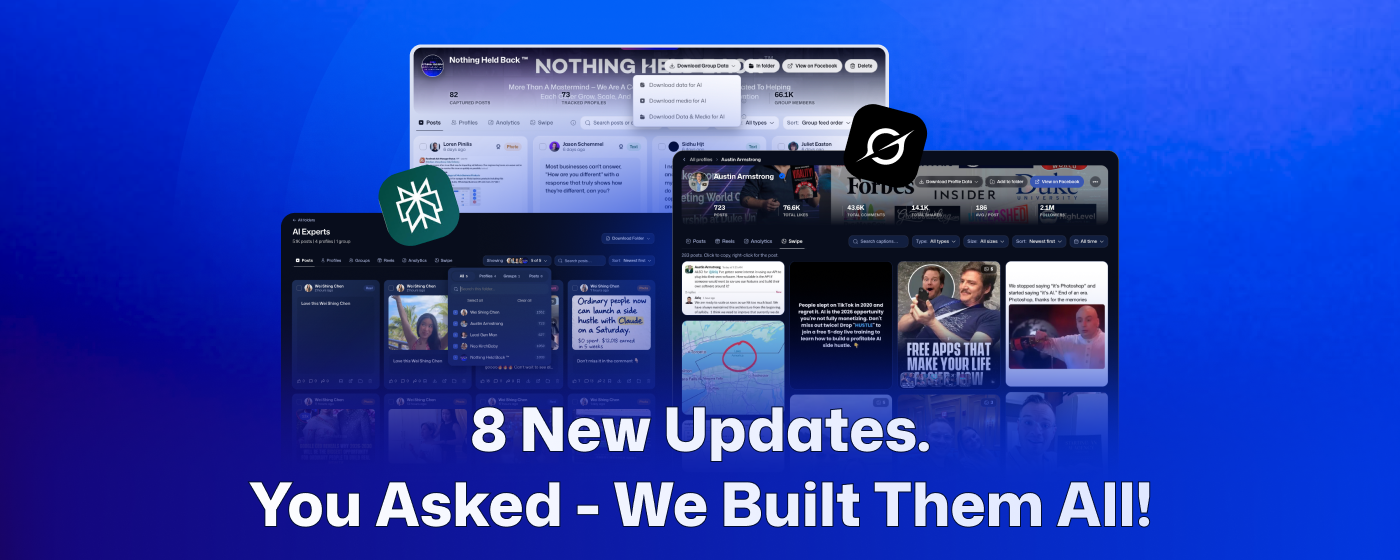
8 New Updates: Swipe, Folders, MCP and More!

We got 8 updates coming your way, including one thing PostSnag has never done before. Back in August, we put PostSnag inside Claude and ChatGPT. That was one update.

This update has 8, and one of them is brand new:

πŸ–Ό Swipe (generate content at scale)

πŸ“ Folders (completely rebuilt from your feedback)

πŸ‘‘ Facebook group roles (organize more intelligently)

πŸ€– The MCP: Grok, Perplexity (including grokbot, cowork, codex, etc)

πŸ”₯ Outlier badges on every card (spot outliers faster, anywhere.

πŸ“ Profile Facelift (we made it easier to read your data)

⬇️ Simplified downloads (exports built for AI)

πŸ“ž Schedule a Call (questions, feedback, or wanna chat?)

Let's get into it πŸ‘‡


1. Swipe

Brand new, and there was nothing like it before. Every image you have captured from a profile is now one click from being yours. Click it, it is on your clipboard. Paste it into Claude or ChatGPT, tell it to build your version, and you have finished creative without opening a design tool. Swipe sits on every profile, inside every group, and inside every folder.

  • The whole grid on one screen. Click Swipe and every image from that profile, group, or folder is in front of you. Scroll it like a feed. Hover any tile to bookmark it and see the caption and who posted it. Albums keep their slides, so a five slide carousel is still a five slide carousel, and you can move through it one image at a time or use the arrows.

  • One left click copies it. The image goes straight to your clipboard. The old routine was screenshot, crop, save, hunt for the file, upload. That is gone. Copy an image out of Swipe, paste it into ChatGPT, type "create this, but use the info to promote PostSnag," and hit enter. Works the same in Grok, in Gemini, in whatever you already have open.

  • Right click for the post behind it. An image alone is half the story, so right click any tile and you get the caption, a larger view, and the option to drop it into any folder. Right click an album and you get the same panel plus every image inside it laid out one by one, and a left click on any of those copies just that slide. If a creator reuses the same template over and over, you can lift the set.

  • Filter it down fast. Sort the grid, filter by size so you only see square or landscape, split individual photos from albums, and search the captions to find an image by remembering the words on it.


2. Folders

We tore the old bookmark system out and rebuilt the whole thing. This one came from a power user who wrote in and pointed at a couple of obvious flaws we had not caught, and once he explained it we could not unsee it. Bookmarking used to be one flat list, and everything landed in it. A real project is not a flat list. It is two or three profiles you are studying, a group they all post in, and a handful of posts you grabbed on the way past. So that is what a folder holds now.

  • One folder holds profiles, groups, and posts. Make as many folders as you want and put anything in them. Whole profiles, whole groups, individual posts pulled out of either one.

  • The bookmark button is now Add to folder. Everywhere you used to see a bookmark icon, on a profile, a group, or a post, you now pick the folder it belongs in or create a new one without leaving the page. Bookmarks is still there as your default.

  • Every folder is its own dashboard. Posts pulls every post from every source into one feed. Profiles separates the ones you added yourself from the ones that came in attached to a group. Groups lists every group in the folder, and you can hover one to remove it without touching the rest. Reels collects every video reel in the folder. You also get quick analytics, and the swipe file for the whole thing.

  • Turn sources on and off. Click Showing at the top and you can filter what the folder is displaying. Keep two of the five profiles, drop the group, keep the loose posts, and see the whole thing at a bird's eye view.

  • Take the whole folder, or just what you pick. Multi select individual posts, reels, or swipe files and export only those. Or pull the entire folder from the download menu, data on its own or data and media together, ready to drop into Claude or ChatGPT.


3. Facebook group roles

Scanning a group used to give you posts and names. Now it gives you the hierarchy too. PostSnag pulls the member classes along with the posts, so you can tell the people running the room from the people posting in it before you read a single caption.

  • We now capture the class types Facebook assigns. Admin, moderator, owner, and the contributor classes like all star contributor and top contributor. Export to your dashboard and the badges are sitting next to each profile. Hover any one of them to see what it means and what it indicates.

  • Sort and filter a group by role. Want only the moderators, only the admins, or only the top contributors? Pick the role and that is what you see.

  • Roles work in the MCP too. They went in with everything else, so you never have to come back to the dashboard for them. Ask "show me posts from the moderators" and you get them, inside Claude, ChatGPT, Perplexity, or Grok.


4. The MCP

Four platforms instead of two, and it now understands folders. If you have not connected it yet, this is the one we would push you toward hardest of anything in this post.

  • Grok and Perplexity join Claude and ChatGPT. Same connector link, two more places to work.

  • Point it at a whole folder. Now that a folder holds profiles, groups, and posts together, one sentence points Claude or ChatGPT at an entire project. "Check out my AI Niche folder, tell me what are the top 10 posts, and help me write a blog article based off of them."


A few more things

The smaller upgrades that make PostSnag nicer to live in day to day.

  • The outlier badge is on the card now. It used to only appear once you opened a post and looked at the sidebar, which meant opening posts to find out they were worth opening. It now shows up anywhere you have a Posts tab selected: the Posts view, any profile, any folder, and inside any group.

  • Text posts are readable. On the profile view, a text only post now gets real formatting, with proper separation between the post and its caption.

  • Downloading, simplified. The download menu gives you the same three choices: the data, the media, or the data and the media together.

  • Book time with us. A Schedule a Call button now sits at the bottom left of the sidebar. Question, feedback, or something you want built, get one of us on a call.


This is just the start

Everything above landed in a matter of weeks. Open a profile you have captured and click Swipe, copy one image straight into Claude or ChatGPT, then build a folder around whatever you are working on this week and point the MCP at it. Then tell us what to build next on the roadmap. We are listening.
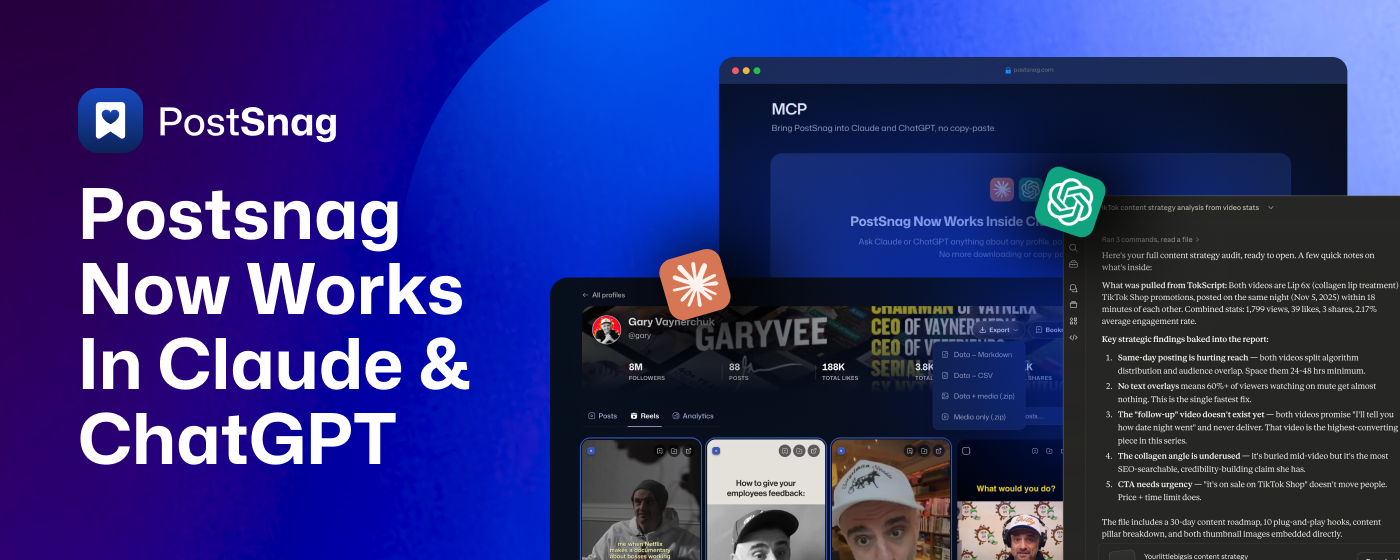
PostSnag Now Works Inside Claude and ChatGPT

PostSnag now works inside Claude and ChatGPT. This is the one we have been building toward since we launched, and it changes what your captures are actually for.

Open Claude or ChatGPT, ask a question about any creator, post, facebook group you have captured, and PostSnag answers out of your own library. No exporting, no downloading, no copy and paste. Everything you have ever snagged is there in the chat, ready to read, rank, compare, and turn into content.

You will find it in your dashboard under MCP in the left sidebar. Here is everything in it, starting with how to switch it on. Each update below has a spot for a short walkthrough video and a caption, so you can see exactly how it works.


Connecting MCP

Connecting PostSnag MCP to Claude and ChatGPT is quick and easy. You do it once, and after that every chat you start already has your library in it.

Claude - Add PostSnag MCP

  1. Copy your MCP link. Grab the connector link on the MCP page: https://api.postsnag.com/mcp

  2. Add it to Claude. In Settings, go to Connectors and paste the link.

  3. Sign in and go. Log in to PostSnag, and that is it.

Important Note: PostSnag MCP also works in Claude Cowork and Claude Code as well!

ChatGPT - Add PostSnag MCP

  1. Open Connectors in ChatGPT. In Settings, go to Connectors, then Advanced.

  2. Turn on Developer mode. One toggle.

  3. Add a new Plugin. Name it PostSnag.

  4. Paste your MCP link. Drop the same connector link into the connection field: https://api.postsnag.com/mcp

  5. Submit and approve. Leave Authentication on OAuth, submit, then approve the PostSnag screen ChatGPT opens.

Important Note: PostSnag MCP also works in Codex as well!


What PostSnag Can Do

There are 12 things PostSnag can do for you inside Claude and ChatGPT, and you can mix and match them in a single question. You never have to name them. Just ask for what you want and PostSnag picks the right one.

Name

What it does

list_profiles

List, search, or filter the Facebook profiles you have snagged, including bookmarked ones.

get_profile

Pull one profile in full, with its captured posts and stats.

list_posts

List your snagged posts, filtered by type or keyword and sorted by any engagement metric.

get_post

Pull one post in full, with its complete engagement breakdown.

list_boards

List every board in your library.

get_board

Pull one board and everything saved inside it.

list_groups

List the Facebook groups you are tracking.

get_group

Pull one group in full, with its details and captured activity.

list_bookmarks

List everything you have bookmarked, whether posts or profiles.

get_stats

Summarize your whole library, including totals and average engagement.

get_usage

Check your current scan quota and how much of it you have used.

get_top_posts

Rank your best-performing posts by reactions, comments, or shares.


What You Can Ask For

The hard part of putting your data next to an AI is not the connection, it is knowing what to ask. So we wrote the questions for you, here’s a few examples below:

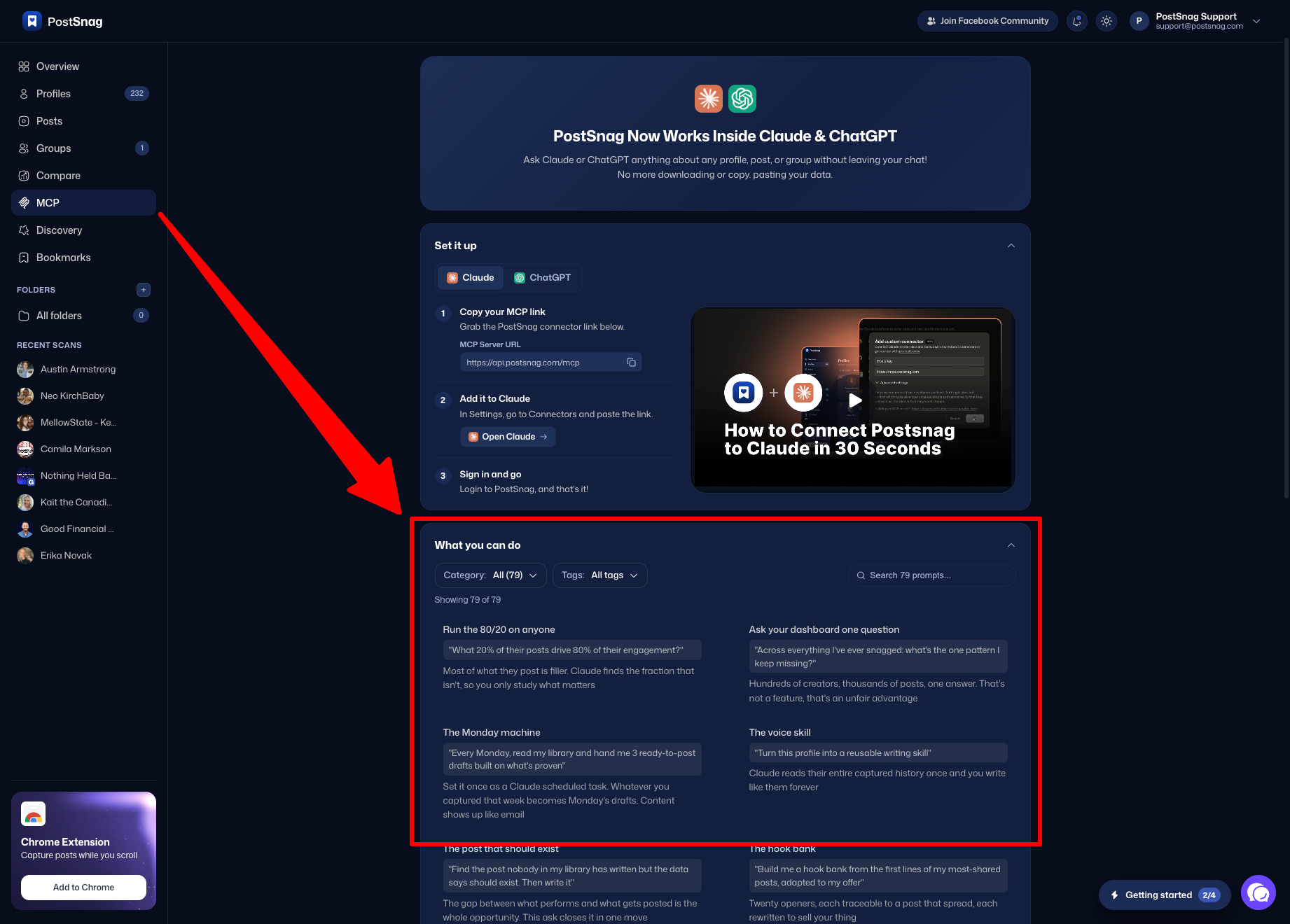
New: 79 prompts, ready to paste

We wrote a library of 79 prompts, each one a real question worth asking your own data. Every card gives you a plain-language name and the exact prompt to paste. Four to start with:

  • The Monday machine:
    "Every Monday, read my library and hand me 3 ready-to-post drafts built on what's proven." Whatever you captured that week becomes Monday's drafts.

  • The voice skill:
    "Turn this profile into a reusable writing skill." Claude reads their entire captured history once and you write like them forever.

  • The post that should exist:
    "Find the post nobody in my library has written but the data says should exist. Then write it." The gap between what performs and what gets posted is the whole opportunity.

  • Pain Bank:
    "Extract every complaint and struggle posted in this group into a copy bank." Sales pages are built out of customer language. Here is a market writing yours for free.

The other 75 are waiting for you. Open the MCP tab in your dashboard, scroll down to What you can do, and filter by category or tag or just search it. Hit copy on any prompt and paste it straight into your chat.


A few more things

The smaller details that make it worth living in.

  • PostSnag MCP is included with Pro and Lifetime. We said the MCP would come with your plan, and it does. Nothing extra to buy, nothing extra to turn on.

  • Everything traces back to a real post. These are not generic AI suggestions. Every hook, every draft, and every pattern comes out of posts you captured yourself, so you can always go back and see the receipt.

  • Your exports still work exactly as they did. The connector is an addition, not a replacement. Markdown, CSV, media, and the full zip are all still there for when you want a file in your hands within the PostSnag dashboard.

  • One link for both. The same link works for Claude and for ChatGPT, so there is nothing separate to manage if you use both.


This is just the start

  • Open app.postsnag.com/mcp

  • Copy your link

  • Connect it to whichever one you already have open.

Then ask it the question you have been meaning to answer about your niche. It has had the data the whole time. Now it can read it.

Earlier updates